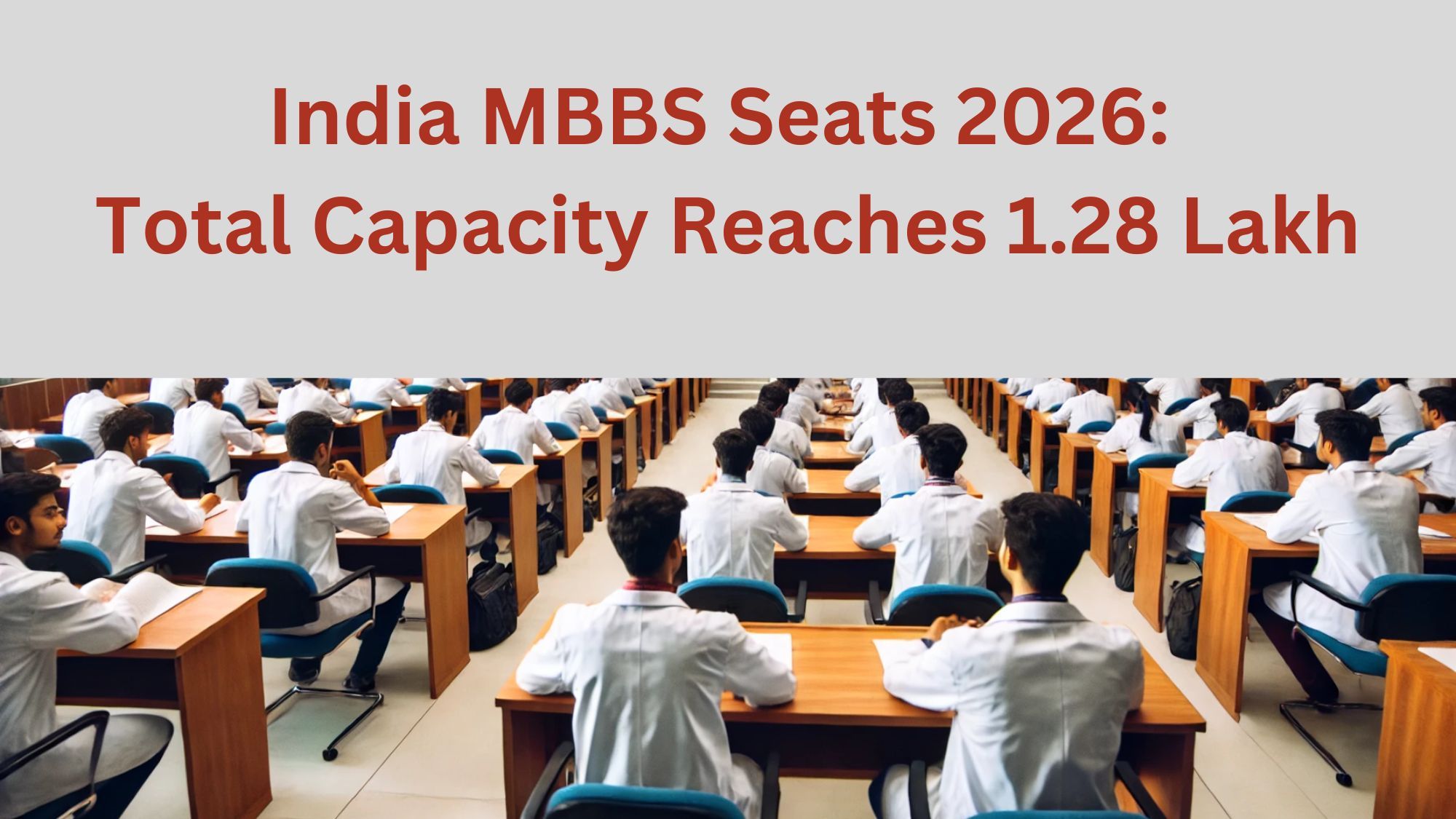
The medical education sector in India has reached a significant milestone in its infrastructure development. As the 2026 admission cycle approaches, latest data indicates that the total number of MBBS seats across the country has scaled to approximately 1.28 lakh. This expansion is the result of a multi-year effort by the central and state governments to address the shortage of healthcare professionals and improve the doctor-to-patient ratio in rural and urban areas alike.
The increase in capacity is distributed across both government and private medical institutions. This growth is largely supported by the Centrally Sponsored Scheme for the establishment of new medical colleges attached with existing district or referral hospitals. As a result, many districts that previously lacked medical training facilities now host fully functional colleges.
Drivers of Seat Expansion
The primary driver of this seat surge is the rapid establishment of New All India Institutes of Medical Sciences (AIIMS) and the conversion of district hospitals into teaching hospitals. By late March, the National Medical Commission (NMC) has completed several rounds of inspections to grant letters of permission for the 2026-27 session. These permissions allow existing colleges to increase their intake and new colleges to begin their first year of operations.
In addition to new institutions, many existing government medical colleges have utilized the Economically Weaker Section (EWS) quota provisions to upgrade their infrastructure and add more seats. This systematic scaling ensures that the competitive pressure on NEET UG aspirants is balanced by a broader pool of available opportunities.
Regional Distribution and Accessibility
The growth in MBBS seats is not restricted to traditional educational hubs. States like Tamil Nadu, Karnataka, and Maharashtra continue to lead in total seat counts, but significant progress has been observed in Uttar Pradesh, Rajasthan, and West Bengal. The goal is to ensure that every state has enough medical graduates to support its local health centers.
For candidates, this geographical spread means more options closer to home. However, the competition remains high, as the number of applicants for the NEET UG exam continues to rise alongside the seat count. The 1.28 lakh seats represent a diverse range of learning environments, from long-standing heritage institutions to modern, technology-driven new campuses.
| Medical Education Growth Overview 2026 | Statistics & Details |
| Total MBBS Seats (Approx.) | 1.28 Lakh |
| Total Medical Colleges | 700+ |
| Government Seat Share | ~55% |
| Growth Percentage (5-Year Period) | Over 80% |
| Primary Admission Exam | NEET UG |
| Current Phase | NMC Inspection & Seat Matrix Finalization |
Impact on the 2026 Admission Cycle
As the academic community moves toward the NEET UG examination, the finalized seat matrix will play a crucial role in counseling strategy. The increased capacity is expected to slightly lower the "cut-off" ranks for various categories in several states. However, experts suggest that while more seats are available, the preference for government colleges remains high due to lower tuition fees and higher clinical exposure.
The registration phase for the national entrance exam has already seen a record number of applicants. With the exam scheduled for early May, students are now focusing on their final revisions. The availability of 1.28 lakh seats provides a clearer roadmap for these students as they identify their target institutions based on previous year trends and the new seat additions.
Quality Control and Standardized Education
Despite the rapid expansion, the NMC maintains a strict check on the quality of education. The commission’s "Minimum Requirements for Annual MBBS Admissions Regulations" ensure that every new seat added is backed by adequate faculty, clinical material, and laboratory space. The review process continues throughout the year to ensure that even newly established colleges maintain a high standard of medical training.
The shift toward a more robust medical registry also helps in planning for postgraduate needs. As the undergraduate pool grows, the government is simultaneously working on increasing PG seats (MD/MS) to ensure that these 1.28 lakh graduates have paths for specialization in the future.
Conclusion
The achievement of 1.28 lakh MBBS seats is a testament to India’s commitment to expanding its healthcare education infrastructure. As the 2026 cycle moves forward, this increased capacity offers a renewed sense of hope for millions of medical aspirants. While the registration for the upcoming entrance exam reflects the high demand for medical careers, the expanded seat matrix ensures a more inclusive selection process. For candidates, the current period is about maintaining academic focus as they prepare for the evaluation phase. The long-term impact of this expansion will be felt in the coming decade as these students graduate to serve the nation’s diverse healthcare needs. With the NMC still reviewing a few final proposals, the medical landscape is set for a productive and transformative academic year.