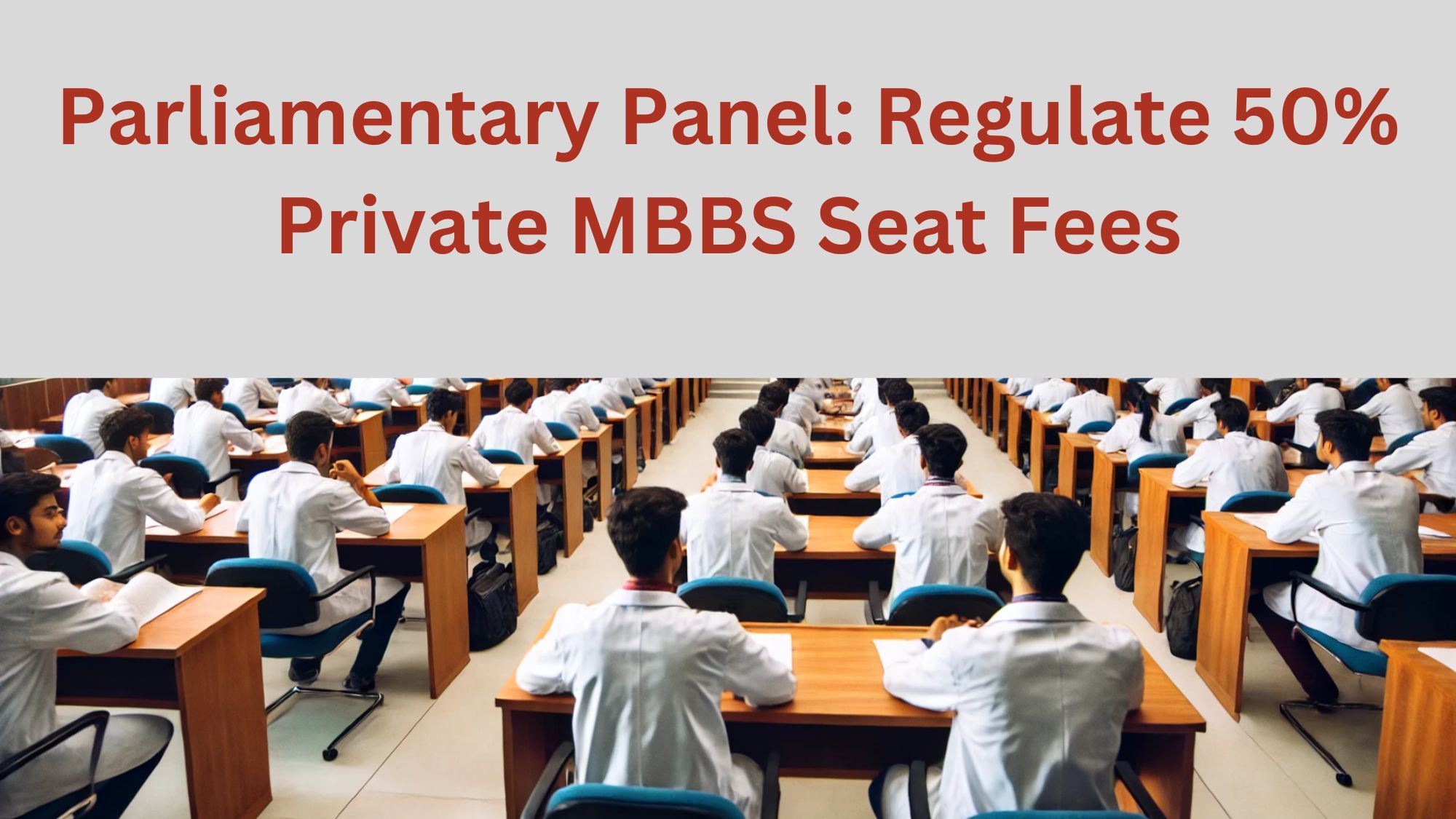
The Department-related Parliamentary Standing Committee on Health and Family Welfare presented its 167th report to the Rajya Sabha on December 11, 2025, delivering a scathing critique of the current state of medical education in India. The report identifies two primary obstacles to accessing an MBBS seat: the soaring cost of education and the severe, uneven distribution of seats across the country. The panel explicitly stated that the prohibitive cost—which can range from ₹60 lakh to over ₹1 crore—makes it appear "as if there are no takers for the poor guardian" to admit their children to medical colleges. The findings call for urgent policy reforms by the National Medical Commission (NMC) and the Union Government.
Prohibitive Cost and Fee Regulation Recommendations
The affordability of medical education remains the single biggest challenge, forcing many qualified candidates from financially weaker backgrounds to abandon their dreams or seek education abroad. The Committee made forceful recommendations to mandate fee control in the private sector.
- Affordability Crisis: The panel observed that the huge cost of medical education effectively excludes poor families, creating an economic barrier to pursuing an MBBS degree.
- Key Fee Regulation Endorsement: The committee strongly endorsed the crucial recommendation that the government must regulate the fee structure for 50 per cent of seats in all private medical colleges by applying the state government fee rate.
- Remaining Seats: Fees for the other 50 per cent of seats would be determined in consultation with the respective state's Fee Regulatory Committee.
- Scholarship Support: The panel reiterated the necessity of introducing need-based scholarships in collaboration with state governments to support deserving students.
Skewed MBBS Seat Distribution Across States
The Committee highlighted a dramatic geographical disparity in MBBS seat availability, which significantly impacts aspiring doctors based on their domicile. The national average stands at 75 seats per million population, but several states fall drastically short.
- Extreme Imbalance: Southern states like Karnataka, Telangana, and Tamil Nadu enjoy approximately 150 MBBS seats per million, with Puducherry boasting nearly 2,000 seats per million.
- Critically Underserved States: In stark contrast, states like Bihar have a crisis-level low of only 21 seats per million, while many others have less than 50, forcing students to travel far or study overseas.
- NMC Intervention Urged: The panel rejected the government's previous "Action Taken" report and pressed the NMC to immediately issue guidelines for creating new medical colleges in states where the MBBS seats fall below the threshold of 100 per million population.
| State/Region | MBBS Seats Per Million (Approx.) | Status |
| Puducherry | 2,000+ | High Concentration |
| Karnataka/Tamil Nadu | 150 | Above National Average |
| National Average | 75 | Baseline |
| Bihar | 21 | Severely Underserved |
Other Key Findings and Future Reforms
Beyond fees and distribution, the report addressed several other systemic issues vital for the future of medical education and healthcare delivery.
- NExT Exam: The Committee reiterated its support for the early introduction of the National Exit Test (NExT), calling it a necessary "paradigm shift" to standardize the assessment of medical graduates.
- Faculty Integrity: The report stressed that the Aadhaar-based Biometric Attendance System introduced by the NMC should be fully utilized to curb the pervasive problem of "ghost faculty" in medical colleges.
- Intake Expansion: The panel recommended that existing colleges with adequate infrastructure should be allowed to increase their intake up to 250 MBBS seats in a phased manner.
Conclusion: Policy Reform Critical for NEET Aspirants
The Parliamentary Panel's report serves as a strong mandate for transformative reform in India's medical education system, emphasizing that increasing seats must be coupled with making them financially accessible and geographically equitable. The key recommendation for regulating the fees of 50% of private seats could be a game-changer for millions of middle and lower-income aspirants. All future NEET aspirants must continue to monitor the Ministry of Health and NMC announcements regarding the fee regulation guidelines, as their implementation will profoundly affect the cost and accessibility of the MBBS admission process..
For regular updates follow Only Education News. For more details on medical entrance exams and courses, check here: Medical Exams List.